Loading...
Serving San Jacinto, CA and surrounding areas. (951) 474-5006
Your home is only as solid as the concrete under it. We install foundations in San Jacinto designed for clay soils, seismic requirements, and summer heat - with every permit and inspection handled.
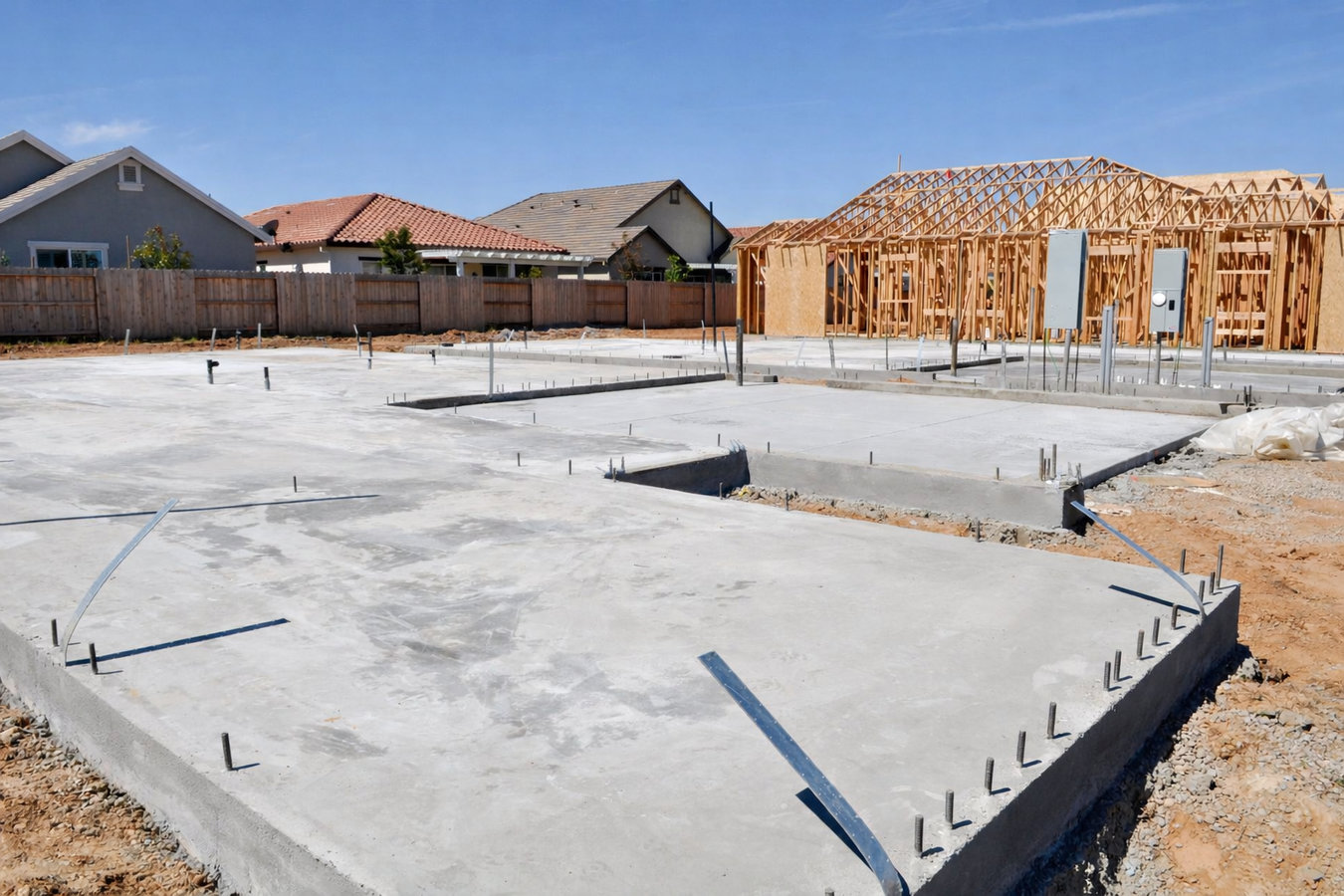
Foundation installation in San Jacinto involves excavating and grading the site, compacting the soil, placing steel reinforcement inside wooden forms, and pouring concrete that will carry your home for decades - most new residential foundations take one to three weeks from permit approval to final inspection, with framing able to start roughly seven days after the pour.
Whether you are building a new home, adding living space, or replacing a foundation that has failed, the work starts well before anyone touches your lot. In San Jacinto, a soil report is typically required by the city before a permit is issued - the clay-heavy valley soils behave differently than the sandy soils common elsewhere in Southern California, and the foundation design has to account for that. Customers building new homes often combine foundation work with our slab foundation building service, which covers the full slab pour in detail.
We give you a written estimate after seeing the lot. We coordinate the soil engineer when needed, pull the permit, and walk you through every stage before it happens.
If doors or windows that used to open and close smoothly have started dragging or leaving gaps at the corners, the frame of your home may be shifting. This is often one of the first signs that the foundation is moving. In San Jacinto, this symptom is especially common after a wet winter followed by a dry summer, when the clay-heavy soils expand and then contract under the slab.
Small hairline cracks in drywall are common and usually harmless. But diagonal cracks running from the corners of windows or doors, or cracks wider than a pencil tip, are worth taking seriously. These patterns often indicate that one part of the foundation has settled or shifted more than another - a condition that tends to get worse over time if left alone.
If you can see cracks in the concrete around the base of your home - especially cracks that are wider at one end than the other, or that run horizontally along a stem wall - that is a direct sign the foundation needs attention. In San Jacinto's expansive soil conditions, these cracks can develop within just a few years if the original foundation was not designed for local soil movement.
If you have purchased land in San Jacinto and are planning to build, foundation installation is simply the first step. But it is worth knowing that the soil conditions here mean you should not skip a soil test before your contractor designs the foundation. A soil report tells the engineer exactly how the ground will behave under load, and the city requires it for most new construction permits anyway.
We install new foundations for single-family homes, ADUs, garages, and additions throughout San Jacinto and the surrounding valley. The most common type in this area is the slab-on-grade - a flat concrete pad poured directly on the ground - but some properties call for a raised foundation with a crawl space underneath. We assess your lot, the structure you are building, and the applicable permit requirements before recommending which system fits your situation. For customers who want to dig into the slab pour itself, our slab foundation building service covers that process in full detail. For commercial properties or large parking areas, we also offer concrete parking lot building, which includes the same base preparation and reinforcement standards we apply to all structural pours.
Every foundation we install goes through the city permit process - we handle the application, coordinate the pre-pour inspection, and obtain the final sign-off. The American Concrete Institute sets the standards for structural concrete we follow on every job.
For single-family homes on bare lots - includes soil assessment coordination, full site prep, steel placement, embedded plumbing coordination, and city permit handling.
Meets City of San Jacinto ADU standards including slab thickness, seismic anchoring, and the habitability requirements the building department checks before issuing a certificate of occupancy.
Matches the elevation and finish of your existing foundation to ensure a flush transition - important for both structural integrity and finished floor appearance.
For homes where the existing foundation has failed or shifted beyond repair - includes demolition, full site re-preparation, and a soil report if the original work was not engineered.
Most of the San Jacinto Valley sits on clay-heavy soils that expand when wet and shrink when dry. In a climate with hot, dry summers and occasional wet winters, that movement is real and it happens every year. A foundation designed without accounting for it will crack. We have seen it in homes throughout the valley - foundations poured by contractors who treated San Jacinto the same as a coastal city with stable sandy soil. The fix is straightforward but requires local knowledge: deeper footings, more steel, proper drainage slope, and a design based on what the ground actually does on that specific lot. San Jacinto also sits near the San Jacinto Fault Zone, which means seismic anchor placement and steel layout are designed for ground movement on every project - not just on jobs where someone thought to ask.
We serve the full valley and the surrounding area. Homeowners in Perris and Banning face similar soil and climate conditions, and we apply the same site-specific approach on every job in those areas.
We visit your property to look at the lot, the slope, and access before giving you any number. You receive a written estimate within 1 business day - itemized so you can see exactly what you are paying for.
For new construction, we coordinate the geotechnical soil report and submit the permit application to San Jacinto's Building Division. Plan review takes one to three weeks. No work begins until the permit is posted on site.
The crew excavates and grades the soil, sets forms, and places all steel reinforcement to the approved plan. A city inspector must then sign off on the steel before any concrete is ordered - this inspection is mandatory.
Concrete is poured, finished, and cured using hot-weather methods when needed. Framing can begin after about seven days. The city conducts a final inspection before the permit is closed out and you receive the documentation.
We visit your lot, review your soil conditions, and give you a written bid before any work begins - no obligation to commit.
(951) 474-5006We account for San Jacinto Valley clay soils on every foundation we install - deeper footings, more steel, and drainage provisions that reflect what the ground actually does here. This is not an upsell. It is how foundations in this valley need to be built.
San Jacinto sits near one of the most active fault systems in California. Every foundation we install is designed with seismic anchor bolt placement and steel layout that meets California requirements for this region - verified by the city inspector before the concrete goes in. The California Geological Survey maps seismic hazards that directly inform local building requirements here.
We submit the permit application to the City of San Jacinto Building Division and manage every required inspection ourselves. You receive the closed-out permit documentation when the job is complete - documentation that protects you when you sell or refinance.
We have installed foundations for homeowners throughout the valley - from the Soboba Springs area to the newer subdivisions on the east side of San Jacinto. That local track record means we already know what the city requires and how the soil behaves in different parts of the valley.
A foundation built right the first time is the lowest-cost option long-term. Cutting corners on soil prep, steel, or permits shows up in your home within a few years and costs far more to fix than it saved upfront.
Structural concrete for commercial and residential parking surfaces, using the same base prep and reinforcement standards as foundation work.
Learn moreIn-depth slab-on-grade work for homes, ADUs, and additions - covering the pour, curing protocols, and the full city inspection process.
Learn moreOur calendar fills fast in spring and fall - call now to lock in your start date before the busy season pushes your timeline back.